
Today, I will be talking about the e-commerce models currently available. This information will help us identify the model our business is currently using, and will also allow us to identify opportunities to grow it.
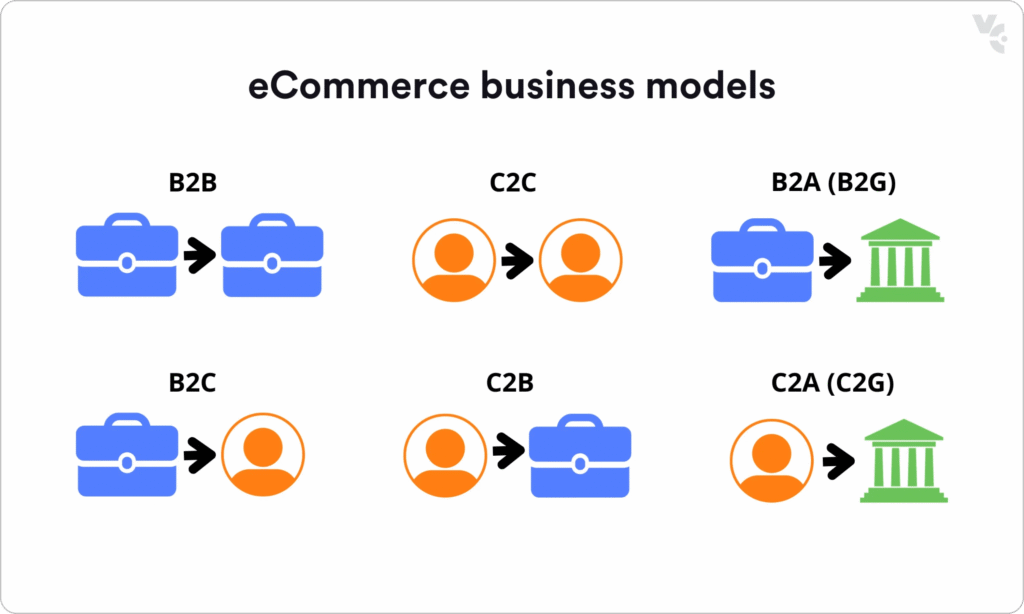
The most common e-commerce models are:
- B2C (Business to Consumer): Companies that sell to end consumers.
- B2B (Business to Business): Companies that sell to other companies.
- C2C (Consumer to Consumer): Transactions between consumers, for example, on websites like eBay.
- C2B (Consumer to Business): Selling products and services to businesses.
- B2G (Business to Government): Companies that sell to the government.
- G2C (Government to Citizen): The relationship between citizens and public administrations.
- B2E (Business to Employee): Transactions between the company and employees
Of the previous models, we will talk in more detail about the first two, B2C and B2B.
What is B2C commerce?
The B2C or business-to-consumer business model is a commercial structure where companies sell their products and services directly to end customers, eliminating intermediaries.
In short, they are organizations that manufacture or generate their own products and market them directly, without going through external distribution systems, reaching consumers directly from the factory.
Advantages
*The primary market is the end customers.
*No intermediaries needed
*More potential customers
*More logistical possibilities
Sales costs are reduced
It can be sold retail or wholesale
Products can be promoted on social media
*Internationalization and diversification
Disadvantages
* Customer distrust regarding payment security
* Lack of knowledge about the seller and the quality of the product
More marketing is needed to reach and retain consumers.
What is B2B commerce?
The B2B model is a model where companies sell their products or services to other companies, with large organizations as their main target.
Advantages
Higher sales volume, as they regularly work with larger-scale orders
Automated sales processes between companies, suppliers, and distributors
Reduction of infrastructure costs and overhead expenses
Less need for intermediaries, greater growth prospects
Ability to reach a mass market at scale
Disadvantages
*Number of customers limited (depending on products offered)
*Delivery times may be longer than for B2C orders due to the quantity of product.
*Customers generally look for discounts due to the quantity of products purchased.
* The level of requirements is more rigorous, and more sophisticated risk management is required.
*When trading with companies, business transactions can become complex.
Differentiators between B2C and B2B models:
- Purchase times: For B2C commerce, the purchase decision is much faster because the customer takes the action themselves. For businesses, however, this involves a series of processes and approvals that delay activities.
- Frequency: Generally, B2C customers tend to return to companies through loyalty strategies, while for the B2B model, it usually takes longer, although it can lead to long-term partnerships with suppliers.
- Price: For B2C companies, unit prices are usually higher, and for B2B companies, they tend to be lower due to the volume of purchase.
- Influences: The factors that drive purchases in a B2C business are personal tastes and marketing campaigns, while in B2B, they are influenced by market changes, societies and statistical analysis, among others.
We can conclude that e-commerce models have experienced significant growth in recent years, allowing entrepreneurs to expand their reach and connect with a wider audience. However, this growth also presents challenges, particularly regarding data protection, cybersecurity for their customers, and technological changes.